Learning From Life

What’s the best piece of advice you’ve ever received?

Some of the best advice I got early on in life was to listen more and talk less.

As I served by time in the Army listening became a crucial skill to communication with others.

As I got married and had kids listening helped me understand what they needed from me.

As I lost my first wife to a tragic accident listening helped me and others around me deal with the loss.

As I eventually remarried to a wonderful woman and partner in life we used listening and talking to slowly build our relationship.

Always listen and you will learn a great many things in life.

Steaks, Steaks and more Steaks plus Seafood.

What are your favorite types of foods?

I grew up very poor and did not even know about steaks or about charcoal grills. I was at a friends house in my late teens and their father was going to grill steaks and asked his boys if I was eating supper with them tonight.

The rest was history. I devoured that steak and I was hooked for life. I have had many steaks over the last 50+ years at various restaurants, but my father-in-law and myself probably cook the best steaks we have had.

I love seafood like shrimp, lobster, scallops and oysters. Some of the best oysters I have eaten came from the Apalachicola area around Saint George Island.

Leadership and the way forward…

Do you see yourself as a leader?

Leadership is a hard “value” to nail down. I feel like a leader some days and some days I just want to go with the crowd and see the day done and enjoy my friendships and my life. God bless those who lead each and every day and give them compassion and understanding. Amen!

Watercolor: Just Start Painting

Watercolor painting can be a wonderful and rewarding experience for beginners, and it all starts with learning how to apply the base color. Here are some tips to get you started:

  1. Choose your paint and paper: Watercolor paints come in different forms – tube, pan, and liquid – and paper quality can vary as well. As a beginner, it’s best to start with student-grade paints and paper until you get more comfortable with the medium.
  2. Prep your workspace: Cover your workspace with a plastic sheet or newspaper to protect it from spills. Fill your water container with clean water and have a paper towel or rag nearby to blot your brush.
  3. Mix your paint: Start by mixing your paint to the consistency you want. Add a small amount of water to the paint to create a thin consistency or keep it thicker for more saturated color.
  4. Apply the base color: With a clean brush, apply the base color to the paper. Start with light brushstrokes and gradually build up the color. Be careful not to overwork the paper, as this can cause it to pill or tear.
  5. Let it dry: Once you’ve applied your base color, let it dry completely before adding any other colors or details. This can take anywhere from a few minutes to several hours, depending on the humidity and temperature.

Remember, watercolor painting takes practice, so don’t be discouraged if your first attempts don’t turn out exactly as you’d hoped. Experiment with different paints, papers, and techniques, and most importantly, have fun with it!

My Journey with Watercolor Painting


Hello everyone! Welcome to my blog where I share my passion for art and creativity. Today I want to talk about my experience with watercolor painting, a medium that I have been exploring for the past few months.

I have always loved the look of watercolor paintings, especially the ones that capture the beauty of nature with soft and vibrant colors. However, I was intimidated by the idea of using watercolors myself, as I heard they were difficult to control and unpredictable. I was afraid of making mistakes and ruining my paintings.

But then I discovered Winsor & Newton Cotman Watercolor Half Pan Paints, a range of watercolors that are designed to be accessible, affordable and uncompromising on quality. They use fine art pigments with reduced pigment load than the professional range, making them easier to blend and mix. They also have good tinting strength and lightfastness, meaning they won’t fade over time.

I decided to give them a try and bought a set of 45 half pans, which came in a compact and lightweight case that was perfect for traveling and painting outdoors. The set included a variety of colors that I could use to create different moods and effects, such as Lemon Yellow Hue, Cadmium Red Hue, Ultramarine, Viridian Hue, Burnt Sienna and Payne’s Gray.

I was amazed by how easy and fun it was to use these watercolors. They were smooth and creamy, and they flowed well on the paper. They also dried quickly, which allowed me to layer and glaze without lifting the previous washes. I learned how to create different textures and techniques with watercolors, such as wet-on-wet, dry brush, splattering and lifting.

I also discovered that watercolors are not as unforgiving as I thought. In fact, they are very forgiving if you know how to work with them. For example, if I made a mistake or wanted to change something, I could simply use a clean damp brush or a tissue to lift off the unwanted paint. Or I could use a darker color or a metallic watercolor¹ to cover it up or add some interest.

One of my favorite colors from the Cotman range is Permanent Rose, a bright rose violet that is transparent and quinacridone-based. It is a versatile color that can be used for flowers, skies, shadows and more. It also mixes well with other colors to create beautiful purples, oranges and browns.

I have been having a lot of fun with watercolor painting. It has become one of my favorite hobbies and a way to express myself creatively. I love how watercolors can capture the mood and atmosphere of a scene with just a few strokes and washes.

If you are interested in trying watercolor painting yourself, I highly recommend Winsor & Newton Cotman Watercolor Pan Paints. They are affordable, high-quality and easy to use. You can find them online or at your local art store.

Thank you for reading my blog post. I hope you enjoyed it and found it inspiring. If you have any questions or comments, feel free to leave them below. And don’t forget to subscribe to my blog for more updates on my art journey.

Happy painting!


Fountain Pen Leaking Fun

Fountain pens are a great tool for artists who love to create beautiful drawings and paintings. They offer a unique writing experience that is unmatched by any other writing instrument. Many artists prefer fountain pens over other types of pens because they allow for more creativity and expression in their artwork.

One of the benefits of using a fountain pen with waterproof ink is the ability to paint over your drawings with watercolors. The waterproof ink ensures that your lines won’t bleed or smudge when you add watercolor paints on top. However, there are times when the fountain pen may leak all the ink out onto the paper, ruining your drawing and leaving you frustrated. In this blog post, we will explore the reasons why a fountain pen may leak waterproof ink when using a converter, and how to avoid this issue.

First, let’s talk about what a fountain pen converter is. A converter is a small device that allows you to fill your fountain pen with ink from a bottle, rather than using a pre-filled cartridge. It is a popular choice for fountain pen users who prefer to use their own inks or want to save money by buying ink in bulk.

When using a fountain pen converter with waterproof ink, there are a few things to keep in mind to avoid ink leakage. One reason why a fountain pen may leak with a converter is due to the quality of the converter. Some converters may not fit properly or may have small cracks that allow ink to leak out. It’s important to use a high-quality converter that fits snugly and securely in your fountain pen.

Another reason why a fountain pen may leak with a converter is due to the type of waterproof ink you are using. Some waterproof inks are thicker or more viscous than others, which can cause the ink to clog the converter or the pen’s feed mechanism. This can result in ink leakage and a ruined drawing. It’s important to choose a waterproof ink that is compatible with your fountain pen and converter.

To avoid ink leakage when using a fountain pen with waterproof ink and a converter, it’s important to follow a few simple steps. First, make sure your fountain pen and converter are clean and free of any debris or ink residue. This will ensure that the ink flows smoothly and doesn’t clog the converter or feed mechanism. Second, choose a high-quality converter that fits securely in your fountain pen. Finally, choose a waterproof ink that is compatible with your fountain pen and converter.

In conclusion, using a fountain pen with waterproof ink and a converter can be a great way to add depth and dimension to your artwork. However, it’s important to take care when choosing your converter and waterproof ink to avoid any issues with ink leakage. By following these simple steps, you can ensure that your fountain pen works smoothly, and your artwork is protected from any ink spills or leaks.

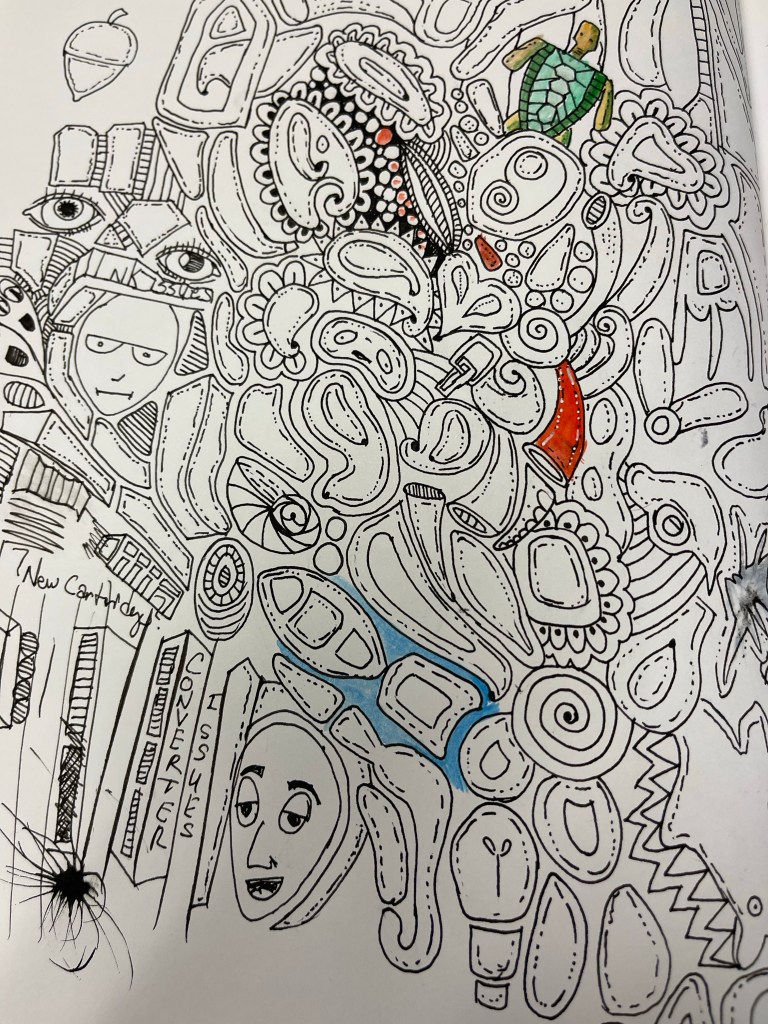
Just doodling around with my Lamy Safari fountain pen

Paint and Brushes

Over the last few years, I have acquired an assortment of paint, palettes, brushes, easels, canvases, art boards and various other art related products. I wanted to share with you some of the products I have bought over the years.

I recently bought a “jelly” gouache paint set which looks awesome. I have not had a chance to use it much, but I can’t wait to see what the paint looks like on a drawing I have made.

Several years back I purchase a watercolor set, Winsor & Newton Cotman Watercolor Studio Set with 45 Half Pans and I have truly enjoyed using the paints from it. I really like this pan as my travel set when we go on vacation. I like to doodle and use the watercolor paint.

I have a large assortment of brushes ranging from very cheap to mildly expensive. I have several palettes along with palette paper and even a wet palette for acrylic.

I really think my focus for right now is experimenting with watercolor and journaling and drawing.

I have to find the time to build my mobile art workstation soon. I have all the materials needed and just need to commit the time to get it done.

For palettes, I have the standard ones you get from the art stores, and I have several small “China” dishes I use and really like for mixing a single colors in.

What do you guys use for palettes? Brushes? Paints? Post your comments.

Getting started with my Art life

It has been a slow journey to get to a point where I want to truly invest in my growth as an artist.

Oh to be sure, I have made many starts and stops with much scribbling and painting through out my life.

At a young age an uncle bought me a couple of pencils and a large art pad back in the early 1970’s and I remember drawing everything I saw. I really remember drawing a pack of Winston cigarettes in great detail. Once I started school the drawing stopped. I tried drawing many times over those school years, but it seemed everyone else around me who could draw did it much better than myself.

I eventually left my hometown and went into the military for a time. I endend up in Germany for a while and discovered the local store had an art section. I purchased some newspaper style art pads and pencils and started drawing again. It was great. Once I left the military I got married and had kids and the drawing stopped again. Many times, I started and stopped drawing. Meanwhile the Intrenet came along, and I found all kinds of resources online for art inspiration.

After 29 years I lost my first wife to a sudden accident and after a time I turned back to Art. I bought brushes, canvases and paint. I spent a lot of time painting and drawing. Hobby Lobby and Michael’s were a frequent stopping place during that season in my life.

A few years later I met a wonderful woman and made her my wife and art kinda took a backseat for a short while, but it is back now, and I want to learn, learn, learn. She is very supportive of my art.

I am a few years away from retirement and want to get myself into a habit of painting and drawing several days a week.

What experiences have any of you had with art in your lifetime?


As a final reminder please like, comment and share this post.

Thanks, Mitchell